What makes a good powder for L-PBF
Sphericity, particle size distribution, flowability and oxygen. The four variables that separate a powder that prints well from one that causes trouble.
In laser powder bed fusion (L-PBF), the printer spreads layers a few tens of microns thick and the laser melts only the part's cross-section. Thousands of layers later, the quality of the part depends largely on something decided before the machine is switched on: the powder. These are the variables that matter most.
1. Sphericity and satellites
Spherical particles roll over each other and form dense, even layers. Irregular particles, or particles with satellites (small spheres stuck to larger ones), interlock, leave gaps in the layer and can cause porosity in the part. That is why morphology is checked with scanning electron microscopy (SEM).
2. Particle size distribution
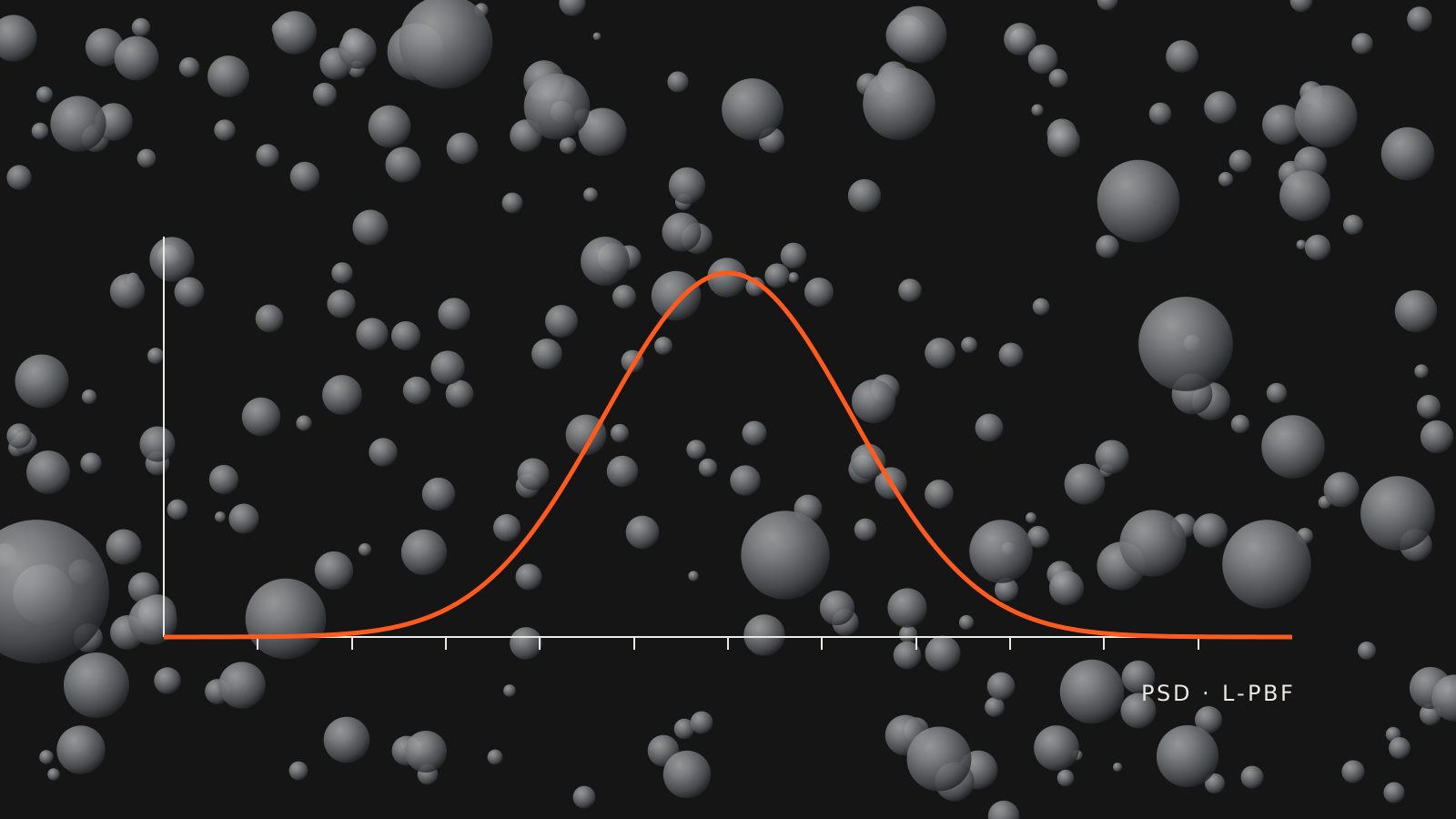
An average size is not enough: the whole distribution matters. It is described with three values, D10, D50 and D90: the diameters below which 10%, 50% and 90% of the powder volume falls.
Too many very fine particles hurt flowability and encourage oxidation; too many coarse particles force thicker layers and a rougher finish. Each process and machine works within its own size window, so the cut is defined case by case.
3. Flowability and density
A powder that flows well spreads evenly across the whole build plate. It is measured with flow tests and with apparent and tap density; the ratio between the two densities gives a quick idea of how the powder will pack in each layer.
4. Oxygen and moisture
Oxygen and moisture picked up on the particle surface end up in the part during melting and can degrade its mechanical properties. They are controlled through chemical analysis and careful packaging and handling.
And then: reuse
In L-PBF, unmelted powder is recovered, sieved and reused. Each cycle can shift its particle size and oxygen content slightly, so it pays to monitor the same variables throughout its life.
A good powder is not one that meets the specification once, but one that meets it the same way in every batch.
If you want to compare these parameters with your own process, request technical information.